

Abbas Dhami
Specialist Diagnostic Radiographer
A lot of adults with bow legs or knock knees have just got used to them. Maybe someone pointed it out when you were young, or you noticed it yourself over the years but it was never treated as something serious. Then the knee pain started. Slowly at first, then more regularly, until it became part of daily life. And somewhere along the way, nobody actually connected the two things.
Bow legs and knock knees in adults are not just about how the legs look. They shift the path your body weight takes every time you stand or walk, and that shift puts pressure on joints that were never meant to carry it unevenly. Year after year, that builds into pain, cartilage wear, and sometimes hip and back problems too. Knowing exactly where your alignment sits, measured while you are actually standing, is what makes real treatment possible. That is why a standing EOS scan at ScanAlign can be useful for adults who need clear leg alignment measurements.
What Are Bow Legs and Knock Knees?
Bow legs and knock knees are both forms of leg malalignment. The legs do not sit in a straight line from hip to ankle. They look different, load the knee differently, and need different treatment approaches. Both are more common in adults than most people think, and both can cause ongoing problems when nobody has properly assessed them.
- Bow legs, also called genu varum: The legs curve outward at the knee. Even with ankles together, there is a gap between the knees. Body weight is pushed to the inner side of the knee joint.
- Knock knees, also called genu valgum: The knees angle inward and touch or cross when standing, while the feet sit apart. Body weight shifts to the outer side of the knee joint.
Both can develop from birth, through injury, through one-sided joint wear, or from conditions that affect bone structure over time. Plenty of adults have a degree of either without it ever having been measured.
Bow Legs vs Knock Knees: Key Differences
| Feature | Bow Legs / Genu Varum | Knock Knees / Genu Valgum |
|---|---|---|
| Direction of curve | Legs bow outward | Knees angle inward |
| Medical term | Genu varum | Genu valgum |
| Knee side overloaded | Inner / medial side | Outer / lateral side |
| Visible sign standing | Gap between knees when ankles are together | Knees touching while feet sit apart |
| Common pain area | Inner knee and hip | Outer knee and ankle |
| Arthritis risk | Medial compartment arthritis | Lateral compartment arthritis |
| Surgical option | High tibial osteotomy | Distal femoral osteotomy |
Can Bow Legs and Knock Knees Cause Knee Pain in Adults?
Every time you stand or take a step, body weight travels down a line called the mechanical axis, from the centre of the hip, through the knee, and down to the ankle. When this line passes through the middle of the knee, load spreads evenly across both sides. When the legs are bowed or knock-kneed, that line shifts off centre.
In bow legs, it swings inward and overloads the inner cartilage. In knock knees, it shifts outward and hits the outer side instead. That uneven load does not usually cause a sudden injury. It quietly wears the cartilage down on one side, year after year, until knee pain becomes impossible to ignore. Most people blame age, but the real reason is often the alignment nobody measured.
Other Joints Affected by Leg Malalignment
The knee takes the most obvious hit, but the whole lower body can end up compensating.
- Hips: Abnormal leg rotation changes how the hip socket loads, leading to one-sided hip pain over time.
- Ankles and feet: The foot may compensate for knee malalignment, often causing flat feet or ankle strain.
- Lower back: Pelvic tilt can adjust around the leg misalignment and build into ongoing back pain.
- Leg length differences: Untreated malalignment can create or worsen a leg length discrepancy, adding more load imbalance.
Important Note: Knee pain from bow legs or knock knees is often mistaken for general wear and tear. The real cause, how body weight travels through a misaligned leg, only shows up clearly when the mechanical axis is measured in a standing, loaded position.
What Causes Bow Legs and Knock Knees in Adults?
Some adults have had this since childhood because of how the bones developed or because of conditions that affected bone growth early on. But leg malalignment does not always start young. It can develop or get worse in adult life for several reasons:
- Old fractures or injuries that healed with a slight angular shift in the bone
- Osteoarthritis wearing down cartilage on one side of the knee
- Obesity placing asymmetric load on one knee compartment over many years
- Meniscus damage removing the cushioning that keeps the joint space even
- Conditions like Paget’s disease or rickets that affect bone structure in the lower limb
Because it builds slowly, most people do not notice the alignment shifting. The pain gets put down to other things long before anyone checks the actual leg position.
How Is Leg Alignment Normally Checked — And Where It Falls Short?
Standard assessment for bow legs and knock knees covers a few methods, but almost all of them share the same core problem. They do not always measure the mechanical axis accurately under real body weight. That is the one measurement that actually determines how serious the malalignment is and what should happen next.
What Standard Assessment Usually Includes
- Visual check of leg shape while standing or walking
- Physical measurements with tape or goniometer in a clinical setting
- X-rays taken with the patient lying flat on a table
- General clinical estimate of the degree of bow or knock
Where It Falls Short
- Lying-down X-rays do not show how the knee loads under body weight
- Visual estimates are not precise enough for treatment planning
- Mechanical axis cannot be calculated properly from a lying-down image
- Both legs are rarely compared simultaneously in one image
- Moderate malalignment can be missed or underestimated
This is why weight-bearing imaging compared with traditional imaging is so important for alignment assessment. Standing scans show how the body actually loads the joints in real life.
Why a Standing Scan Changes Everything
The mechanical axis only shows its true position when you are standing with full body weight going through the joints. Lying flat, muscles relax and the joint decompresses. The degree of bow or knock does not present the same way it does in real life. That positional difference can change how serious the malalignment looks and, as a result, what treatment gets suggested.
What a Standing Scan Makes Possible
- Captures the true mechanical axis under real body weight
- Shows the actual degree of varus or valgus as it exists day to day
- Measures both legs at the same time so differences between sides are clear
- Gives precise angles instead of visual estimates for surgical planning
- Shows the full lower limb as one connected system, not separate sections
- Picks up moderate malalignment that lying-down imaging may underestimate
What Is an EOS Scan and How Does It Measure Leg Alignment?
An EOS scan takes simultaneous front and side images of your full lower limbs, from hip to ankle, while you stand naturally inside a scanning cabin. Those images can be used to create a 3D skeletal model, helping clinicians calculate the mechanical axis, hip-knee-ankle angle, and exact degree of bow or knock.
What Makes EOS Different for Leg Alignment?
- Standing position captures true weight-bearing alignment, not a lying-down approximation
- Both legs are scanned at the same time in one image from hip to ankle
- 3D modelling supports precise angular measurements instead of flat estimates
- Lower radiation exposure makes it useful when repeat monitoring is needed
- The scan is quick, open, and does not involve a tunnel
For patients who are worried about scan exposure, ScanAlign’s guide on EOS scan safety and radiation levels explains why EOS is often chosen for people who may need more than one scan over time.
What an EOS Scan Shows for Bow Legs and Knock Knees
A standing EOS scan gives the treating clinician detail that changes how bow legs and knock knees get managed. From the scan, a consultant radiologist can measure and report important alignment details.
- Mechanical axis deviation: How far the weight-bearing line has shifted from the centre of the knee
- Hip-knee-ankle angle: Full alignment of the lower limb from top to bottom on each side
- Degree of varus or valgus: Precise measurement of how bowed or knock-kneed each leg is
- Joint space comparison: Which compartment is overloaded and by how much
- Side-by-side lower limb comparison: Differences between left and right clearly visible
- 3D skeletal model: A complete picture of how each leg aligns while standing
These details can help decide whether treatment should be conservative or surgical. ScanAlign’s guide on what an EOS scan report shows is also useful if you want to understand the kind of measurements included after imaging.
Who Should Get a Standing Leg Alignment Scan?
A standing EOS leg alignment scan is worth considering if any of these apply:
- Visible bow legs or knock knees and daily knee pain is developing
- One-sided knee pain with no clear injury and alignment has never been checked
- You have been told you have early knee osteoarthritis and want to know if malalignment is making it worse
- You are being assessed for or considering osteotomy surgery
- You are an athlete with persistent knee or hip pain on one side that a standard scan has not explained
- You had previous knee surgery and want to check how alignment has settled afterward
At ScanAlign, patients can self-refer and get their measurements without waiting for a GP referral.
Bow Legs in Adults Treatment: What Happens After the Scan?
Once the EOS report is ready and the degree of malalignment is clear, treatment options stop being guesswork. What gets recommended depends on how significant the misalignment is and how much joint damage has already happened.
- Physiotherapy: Targeted work on hip abductors, glutes, and core to reduce uneven knee loading
- Orthotics and bracing: Offloading braces that shift weight away from the damaged compartment
- Weight management: Reducing load through the knee matters even with moderate malalignment
- High tibial osteotomy: For bow legs, realigning the tibia so the mechanical axis passes through the knee centre
- Distal femoral osteotomy: For knock knees, repositioning the lower femur to correct the valgus angle
- Knee replacement: For advanced joint damage where joint preservation is no longer realistic
EOS data can make surgical planning far more precise because the surgeon has exact correction measurements before treatment begins.
What Happens at a ScanAlign EOS Appointment?
The process at ScanAlign is straightforward from beginning to end. You can also read the full guide on what happens during an EOS scan before your appointment.
1. Free Video Consultation
A specialist reviews your symptoms and history before you travel anywhere, helping confirm whether EOS is the right next step.
2. Arrive at Harley Street Hospital
No preparation, injection, or contrast dye is needed. Comfortable clothing is usually best, and metal items may need to be removed.
3. 15-Second Standing Scan
Both legs are scanned from hip to ankle while you stand naturally. There is no tunnel and no uncomfortable recovery period afterward.
4. Consultant Radiologist Report
A UK-trained specialist produces a detailed report with mechanical axis measurements, angles, and your 3D skeletal model.
5. Doctor Follow-Up
A doctor takes you through the findings, explains what the numbers mean, and talks through treatment options.
Important Note: EOS uses lower radiation than many standard X-ray methods. For adults who need repeat scans to track alignment changes or check results after treatment, that difference in exposure can matter over time.
Conclusion
Most adults with bow legs or knock knees have never had a proper standing measurement done. They may have had lying-down scans, a visual check, or a brief comment that the legs are slightly curved, but not an actual number showing how far the mechanical axis has shifted and what that means for the knee going forward.
Without that measurement, any treatment plan is built on an estimate. And when knee cartilage is wearing away, an estimate is not enough.
A standing EOS scan gives that measurement quickly, precisely, and in full 3D. It tells both you and your doctor exactly what is happening and where treatment needs to go. That is where managing bow legs and knock knees in adults properly has to begin.
Still Guessing? Get Your Leg Alignment Measured Properly
At ScanAlign, Harley Street Hospital, a standing EOS scan measures bow legs or knock knees while you stand under real body weight. No GP referral is needed. Book your free video consultation today.
FAQs
- 1. Can bow legs in adults be treated without surgery? Yes. For mild to moderate bow legs, conservative treatment can make a real difference. Targeted physiotherapy, offloading knee braces, and orthotics can all reduce pain and slow joint deterioration. Surgery becomes more relevant when the malalignment is significant and conservative options are not enough to protect the joint.
- 2. Do bow legs and knock knees get worse with age? They can, especially when arthritis develops on one side of the knee. As cartilage wears unevenly, the joint space narrows and the leg may gradually bend further in the direction of the existing malalignment. Getting it measured early and monitoring it over time can be very useful.
- 3. Can bow legs cause knee pain even if there is no injury? Yes. Pain from bow legs can come from uneven load distribution, not a specific injury. The inner cartilage takes more force than it is designed for on every step, and over time that can cause pain and wear without any accident happening.
- 4. What is the best scan to check leg alignment in adults? A standing full-length EOS scan is one of the most useful options because it captures the full mechanical axis from hip to ankle under real body weight. It also measures both legs at the same time and supports detailed 3D alignment assessment.
- 5. How does an EOS scan measure bow legs or knock knees? EOS takes simultaneous front and side images of both lower limbs while you stand. From those images, clinicians can calculate the mechanical axis, hip-knee-ankle angle, and exact degree of varus or valgus on each side.
- 6. How do I book a standing leg alignment scan in London? You can book directly at ScanAlign, Harley Street Hospital, without a GP referral. Start with a free video consultation so a specialist can review your situation and confirm whether an EOS leg alignment scan is the right next step.
Continue reading
More articles
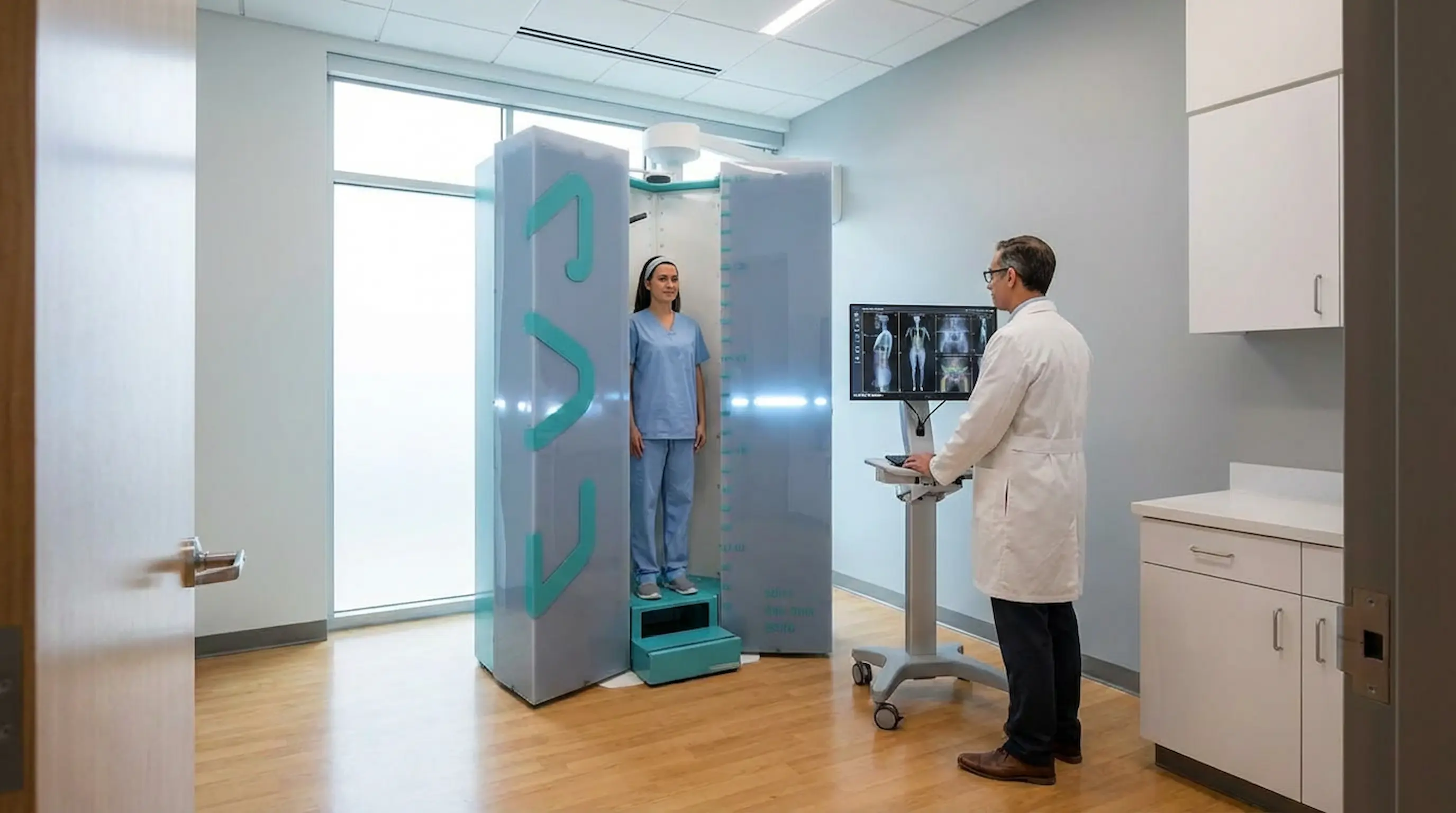
Is EOS Scan Safe? Radiation Levels, Risks, and FAQs
Discover if EOS imaging is safe, its radiation levels, risks, and benefits. Learn why it’s preferred for accurate, low-dose skeletal scans.

EOS Scan for Scoliosis: Why Standing Imaging Matters
Discover how EOS for scoliosis provides low-radiation imaging for accurate spinal alignment and better scoliosis diagnosis and monitoring.
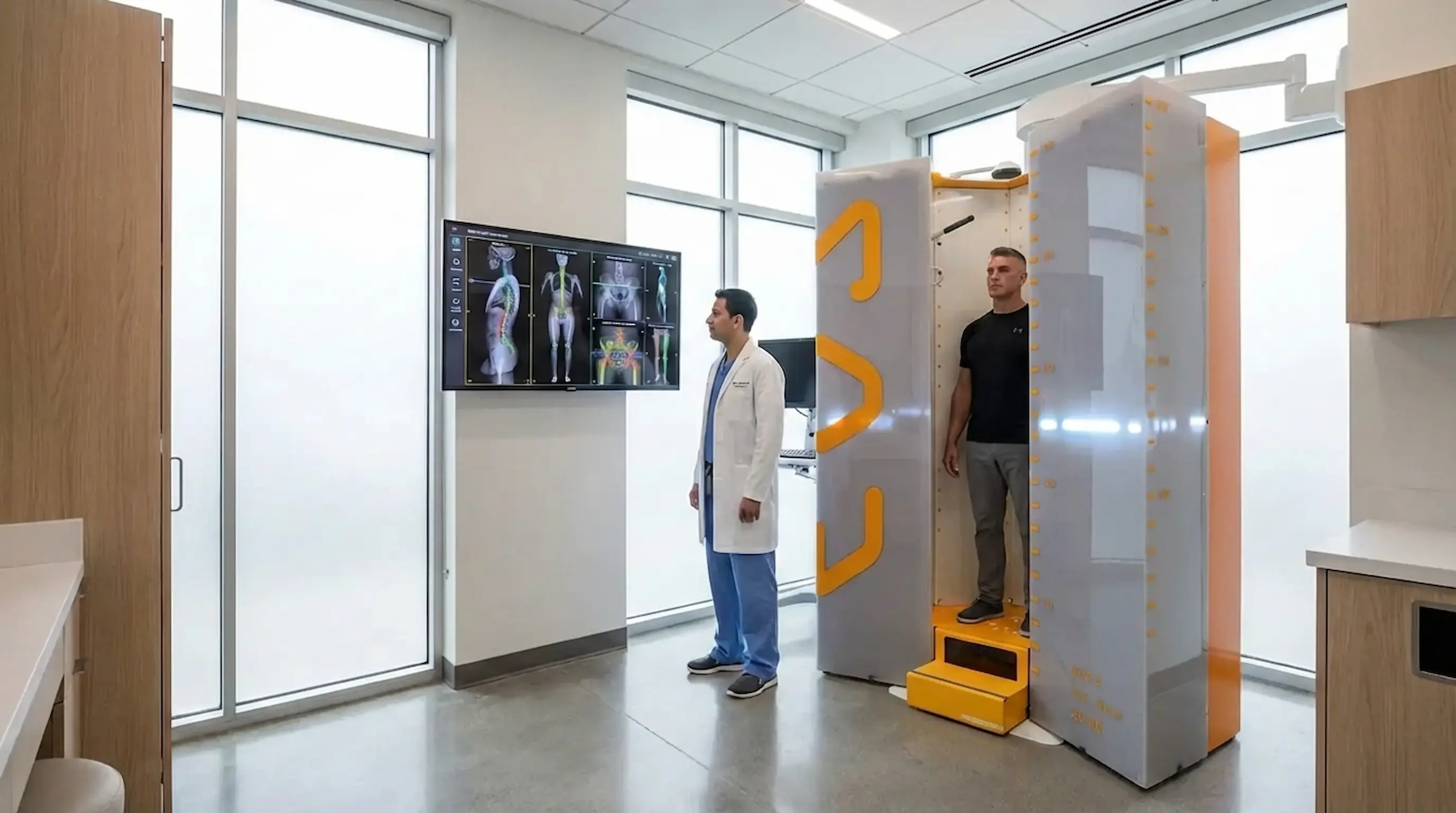
Hip Pain & Alignment: EOS Imaging for Better Diagnosis
EOS imaging for hip pain reveals pelvic tilt, leg length discrepancy & spinopelvic alignment that routine scans miss. Book Appointment now.