

Abbas Dhami
Specialist Diagnostic Radiographer
Getting told you need a new type of scan can raise a lot of questions. What is it? Why this one and not a regular X-ray? Is it safe? What will it actually show? These are completely normal things to wonder, and this blog answers them in simple words.
An EOS scan is a full-body musculoskeletal imaging tool that captures your spine, pelvis, hips, and lower limbs all at once while you stand upright. It creates both 2D and 3D images of your skeleton in under 20 seconds. Doctors across orthopaedics, spine surgery, and paediatric care use it when they need a clear picture of how your bones and joints are aligned under real body weight.
There are several reasons a doctor may recommend EOS instead of standard imaging. This guide walks through the most common ones, so you know what to expect and why this scan may matter for your care.
What Makes EOS Different From Regular Musculoskeletal Imaging?
Before looking at when doctors recommend it, it helps to understand why EOS exists as a separate option. If you want a full breakdown, you can read this detailed guide on what an EOS scan is.
The short version is this: EOS solves a problem that standard orthopaedic imaging often has. Regular X-rays and MRI scans are usually taken while the patient lies flat. That position removes the effect of body weight, which means the scan may not show how the spine, pelvis, hips, and legs behave during normal standing and movement.
EOS captures the full skeleton in a standing position. This helps doctors see how the body is really aligned under natural load.
- It scans the full body from head to lower limbs in one session.
- It shows the body in a natural standing position.
- It creates both 2D images and a 3D skeletal model.
- It provides detailed clinical measurements from one scan.
- It uses much lower radiation than many standard imaging options.
This combination is why doctors use EOS for certain conditions where posture, alignment, and full-body balance matter.
Reason 1 — Scoliosis Diagnosis and Long-Term Monitoring
Scoliosis is one of the most common reasons doctors recommend an EOS scan. It is also one of the conditions where EOS can be especially helpful.
Scoliosis is not just a sideways curve in the spine. It is a three-dimensional spinal condition. It can involve rotation of the vertebrae, changes in rib position, pelvic shift, and changes in full-body posture. A standard flat X-ray may show the curve from one angle, but it may not show the complete picture.
EOS helps doctors assess scoliosis more clearly because it captures the spine, pelvis, and lower limbs in one standing scan.
- It measures Cobb angle in a natural upright position.
- It shows vertebral rotation and spinal balance.
- It helps assess pelvic alignment and body posture.
- It allows doctors to compare scans over time.
- It supports brace monitoring and surgical planning.
This is especially important for children and teenagers who may need repeat scoliosis scans during growth. Because EOS uses a lower radiation dose, it is often preferred for long-term scoliosis monitoring.
Reason 2 — Back Pain That Other Scans Have Not Explained
Back pain can be frustrating when standard scans do not explain the problem. Some patients have X-rays or MRI scans that appear normal, but they still feel pain during standing, walking, or daily movement.
EOS imaging for back pain works differently because it shows the spine under load. This matters because many back pain issues only become clear when the body is standing and carrying weight.
An EOS scan may help doctors identify:
- Sagittal imbalance, where the body’s centre of gravity shifts forward or backward.
- Pelvic tilt, which can place extra stress on the lower back.
- Compensation patterns, where one area of the body adjusts for another problem.
- Leg length difference, which can affect the spine and pelvis over time.
- Spinal rotation that may not be clear on a standard 2D scan.
When pain continues but previous scans do not give a full answer, EOS can provide a more complete view of how the body is aligned in real life.
Reason 3 — Hip Disorders and Hip Replacement Planning
Doctors and orthopaedic surgeons may recommend EOS when a patient has hip pain, hip joint disease, hip dysplasia, or is preparing for hip replacement surgery.
The hip does not work alone. It is closely connected to the pelvis and lower spine. If the pelvis is tilted or the spine is poorly balanced, it can affect how the hip joint moves and loads. EOS helps doctors see this relationship clearly.
For hip conditions, EOS can help by showing:
- The hip-spine relationship in a standing position.
- The position of the pelvis under natural body weight.
- The alignment of the hip socket and surrounding structures.
- Asymmetric wear patterns that may not be obvious on standard imaging.
- Post-surgery implant position and body adjustment.
For hip replacement planning, accurate alignment matters. Surgeons can use EOS data to understand the patient’s real anatomy before surgery and review the result after the procedure.
Reason 4 — Knee Replacement Planning and Lower Limb Alignment
Knee surgeons often use EOS when they need accurate information before knee replacement surgery. This is especially useful in cases of osteoarthritis, bowing of the legs, knock knees, or lower limb malalignment.
Knee replacement success depends heavily on alignment. If the leg is not aligned correctly, pressure may not pass evenly through the knee joint. Over time, this can affect comfort, movement, and implant life.
EOS supports knee planning because it measures the full mechanical axis of the leg from hip to ankle in one standing scan.
- It shows how the knee is loaded under body weight.
- It measures the full leg alignment from hip to ankle.
- It helps surgeons plan implant positioning more accurately.
- It supports decisions about bone correction and joint balance.
- It can be used after surgery to confirm alignment correction.
This makes EOS valuable for both pre-operative planning and post-operative review.
Reason 5 — Measuring Leg Length Discrepancy
Leg length discrepancy means one leg is shorter than the other. Even a small difference can affect posture, walking pattern, pelvic balance, and spinal alignment over time.
Doctors recommend EOS for leg length assessment because it measures both legs at the same time while the patient stands naturally. This gives a more realistic view of how the difference affects the whole body.
EOS can help assess:
- The exact length of each leg from hip to ankle.
- How the pelvis responds to the difference.
- Whether the spine is compensating for uneven leg length.
- How weight is distributed through the lower limbs.
- Whether orthotics, shoe raises, or surgery may be considered.
Because the scan is taken while standing, the results reflect how the body actually behaves in daily life.
EOS Scan Radiation Dose — EOS vs CT Scan vs X-Ray
One of the first questions patients ask is whether an EOS scan is safe. EOS is designed to use a much lower radiation dose than many traditional imaging methods. For the complete safety breakdown, this EOS scan safety guide covers radiation levels and risk in more detail.
| Scan Type | Radiation Dose Compared to EOS |
|---|---|
| EOS standard scan | Baseline ultra-low dose |
| Standard digital X-ray | Usually higher than EOS |
| CT scan | Much higher radiation exposure than EOS |
| EOS Micro Dose protocol | Even lower than a standard EOS scan |
This lower dose is one reason doctors may recommend EOS for conditions that need repeat imaging, such as scoliosis monitoring in children and teenagers.
What to Expect — The EOS Scan Procedure From Start to Finish
If your doctor has referred you for an EOS scan, the process is simple. There is very little preparation, and the scan itself is quick and comfortable.
Before the Scan
- Remove metal items such as belts, jewellery, watches, or hair clips.
- No fasting is needed.
- No injections are required.
- No special clothing is usually needed.
- You do not need to change your normal routine before the scan.
During the Scan
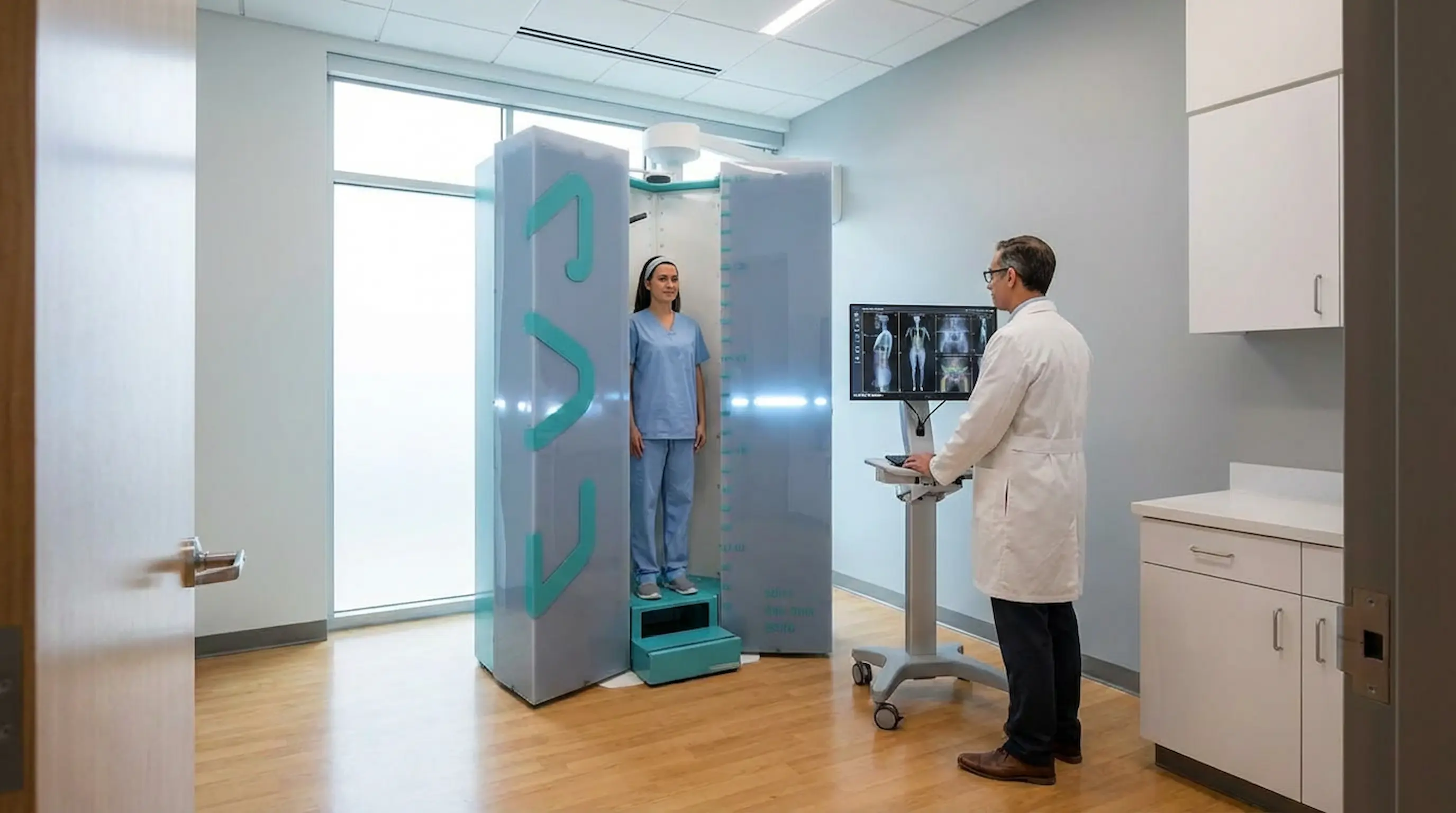
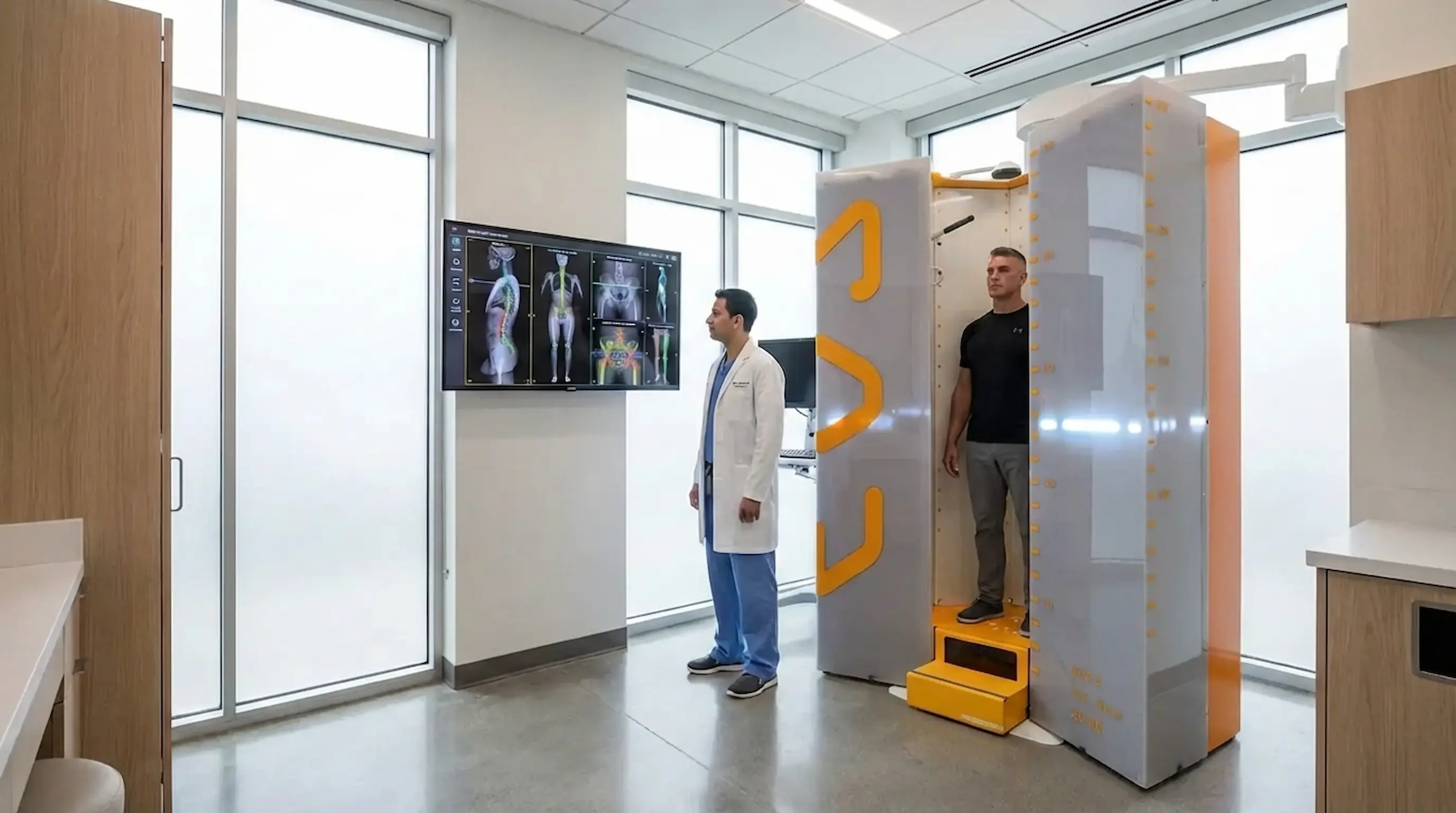
- You stand inside the open EOS cabin.
- The scanner is not an enclosed tunnel.
- The scan usually takes around 15 to 20 seconds.
- Nothing touches you during the scan.
- You may hear a gentle sound as the scanner moves.
After the Scan
- The images are available immediately after the scan.
- A consultant radiologist reviews the images.
- A written report is prepared.
- The results may include key measurements and a 3D skeletal model.
- At ScanAlign, results are reviewed with you in a doctor-led consultation.
The whole process is designed to be quick, clear, and easy for patients to understand.
Do I Need an EOS Scan? Key Signs It Applies to You
Not every patient needs an EOS scan. However, there are clear situations where it can provide information that standard imaging may not show.
You may benefit from an EOS scan if:
- You have scoliosis and need ongoing monitoring.
- You have chronic back pain that previous scans have not explained.
- You are preparing for hip or knee replacement surgery.
- You have been told you may have a leg length difference.
- You have hip joint problems, dysplasia, or unexplained joint pain.
- You are a child or teenager with a spinal condition needing repeat imaging.
- Your doctor needs a standing full-body view of your skeletal alignment.
EOS is generally not used for soft tissue injuries, acute fractures, or conditions where MRI is already the best option. If you are unsure, checking your eligibility for a scan at ScanAlign can help you decide before booking.
Getting an EOS Scan at ScanAlign
ScanAlign offers EOS imaging in the UK from The Harley Street Hospital in London. Unlike many imaging routes, you do not always need a GP or consultant referral. You can self-refer and begin with a free video consultation.
The ScanAlign package includes a video consultation, EOS scan, consultant radiologist report, and doctor-led review of your results. This gives patients a clearer understanding of their findings instead of leaving them with a report they may struggle to interpret alone.
Healthcare professionals can also refer patients directly through ScanAlign’s referral pathway.
Conclusion
Doctors recommend EOS scans when they need the full structural picture. Instead of looking at one isolated area while the patient lies flat, EOS shows the whole body standing upright under natural load.
Whether the reason is scoliosis, ongoing back pain, hip or knee surgery planning, or a leg length difference, EOS gives doctors detailed alignment information that standard imaging may not provide. For patients, it can make the next step feel clearer and more informed.
Think an EOS Scan Might Be Right for You?
Book your free video consultation today. No referral is needed. One short call with the ScanAlign team can help you find out if an EOS scan is the right next step for your condition.
Book Your Free ConsultationFAQs
- 1. What conditions do doctors most commonly recommend an EOS scan for? Doctors commonly recommend EOS scans for scoliosis monitoring, unexplained back pain, hip and knee replacement planning, leg length discrepancy assessment, and post-surgical alignment checks.
- 2. How long does an EOS scan take? The scan itself usually takes around 15 to 20 seconds. The full appointment may take a little longer because of preparation, positioning, and review steps.
- 3. Does an EOS scan hurt? No, an EOS scan does not hurt. You simply stand inside an open scanner while the images are taken. Nothing touches you, and no injections are needed.
- 4. Do I need to prepare before an EOS scan? Very little preparation is needed. You may be asked to remove metal items such as belts, jewellery, or hair clips before the scan.
- 5. How does EOS scan radiation compare to regular X-rays? EOS is designed to use a much lower radiation dose than many standard imaging methods. This makes it useful for patients who may need repeat scans over time.
- 6. Is EOS better than MRI? EOS and MRI are used for different purposes. EOS is helpful for skeletal alignment and posture. MRI is better for soft tissue details such as ligaments, discs, cartilage, and muscles.
Continue reading
More articles
Is EOS Scan Safe? Radiation Levels, Risks, and FAQs
Discover if EOS imaging is safe, its radiation levels, risks, and benefits. Learn why it’s preferred for accurate, low-dose skeletal scans.

EOS Scan for Scoliosis: Why Standing Imaging Matters
Discover how EOS for scoliosis provides low-radiation imaging for accurate spinal alignment and better scoliosis diagnosis and monitoring.
Hip Pain & Alignment: EOS Imaging for Better Diagnosis
EOS imaging for hip pain reveals pelvic tilt, leg length discrepancy & spinopelvic alignment that routine scans miss. Book Appointment now.