
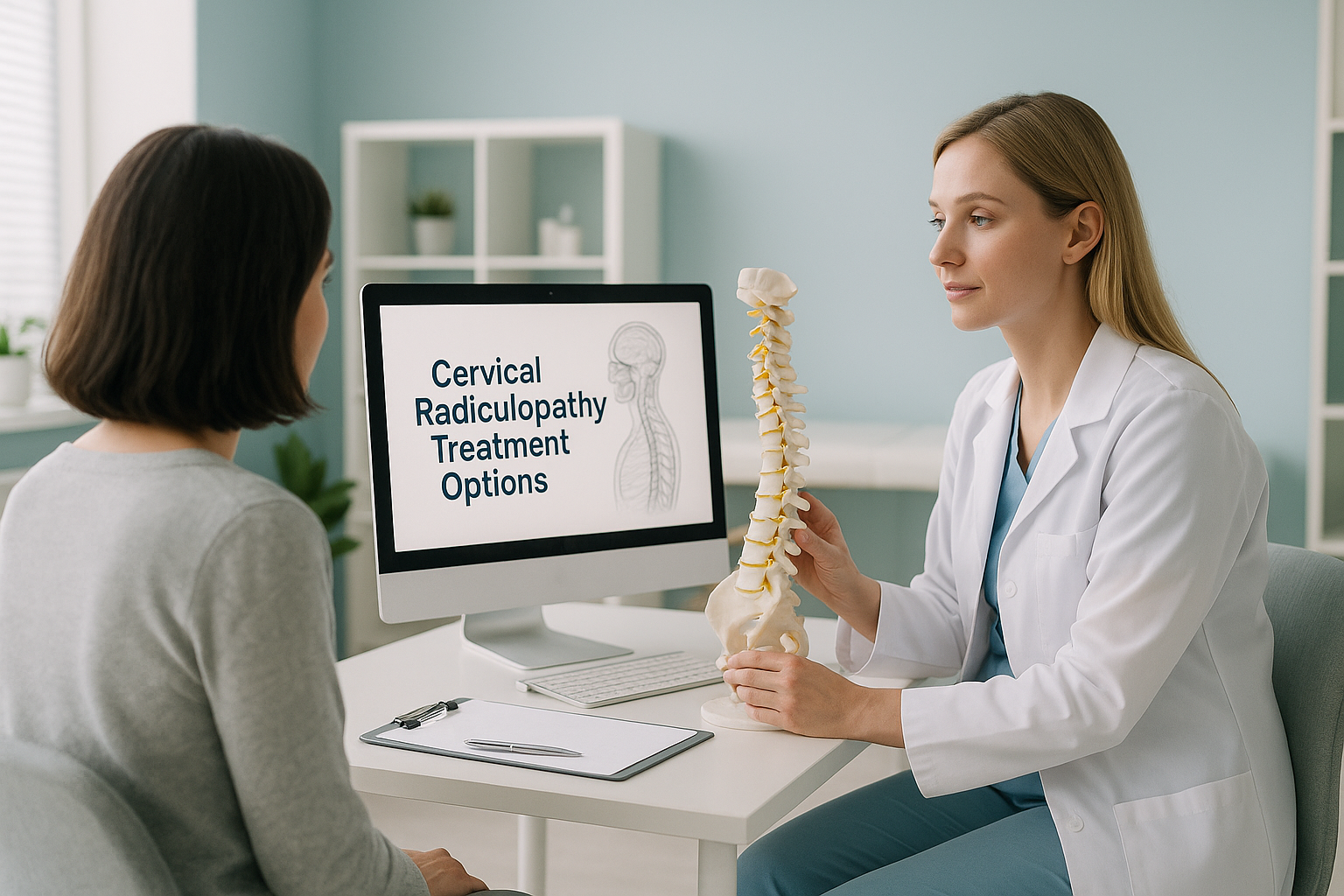
Cervical Radiculopathy Treatment: What Are Your Options for a Pinched Nerve in the Neck?
Cervical radiculopathy treatment usually starts with non-surgical approaches such as physical therapy, pain relief and activity changes. Most people improve within weeks. If symptoms persist, cervical epidural steroid injections or surgery such as ACDF may be considered. The right path depends on accurate imaging that shows where the nerve is compressed.
Key takeaways
- Most pinched nerves in the neck settle with conservative treatment and do not need surgery.
- Physical therapy, posture work and targeted exercises are the first-line approach.
- If conservative care fails, injections or surgical options like ACDF may help.
- Standing whole-body imaging can reveal how your neck alignment changes under load, information that lying-down scans can miss.
- Sudden weakness, loss of grip, or bladder and bowel changes need urgent medical attention.
Important. If you have sudden severe neck pain with numbness, weakness in your arms or legs, difficulty walking, or any change in bladder or bowel control, seek urgent medical attention. Contact your GP, call 111, or go to A&E.
What is cervical radiculopathy?
Cervical radiculopathy is a condition where a nerve root in the neck becomes irritated or compressed as it exits the spine. This can send pain, tingling, numbness or weakness down through the shoulder, arm and into the hand. Some people call it a "pinched nerve in the neck."
The cause is usually a disc bulge pressing on a nerve or bony narrowing of the gap where the nerve passes through (foraminal stenosis). It is most common between the ages of 40 and 60, but it can affect younger adults too.
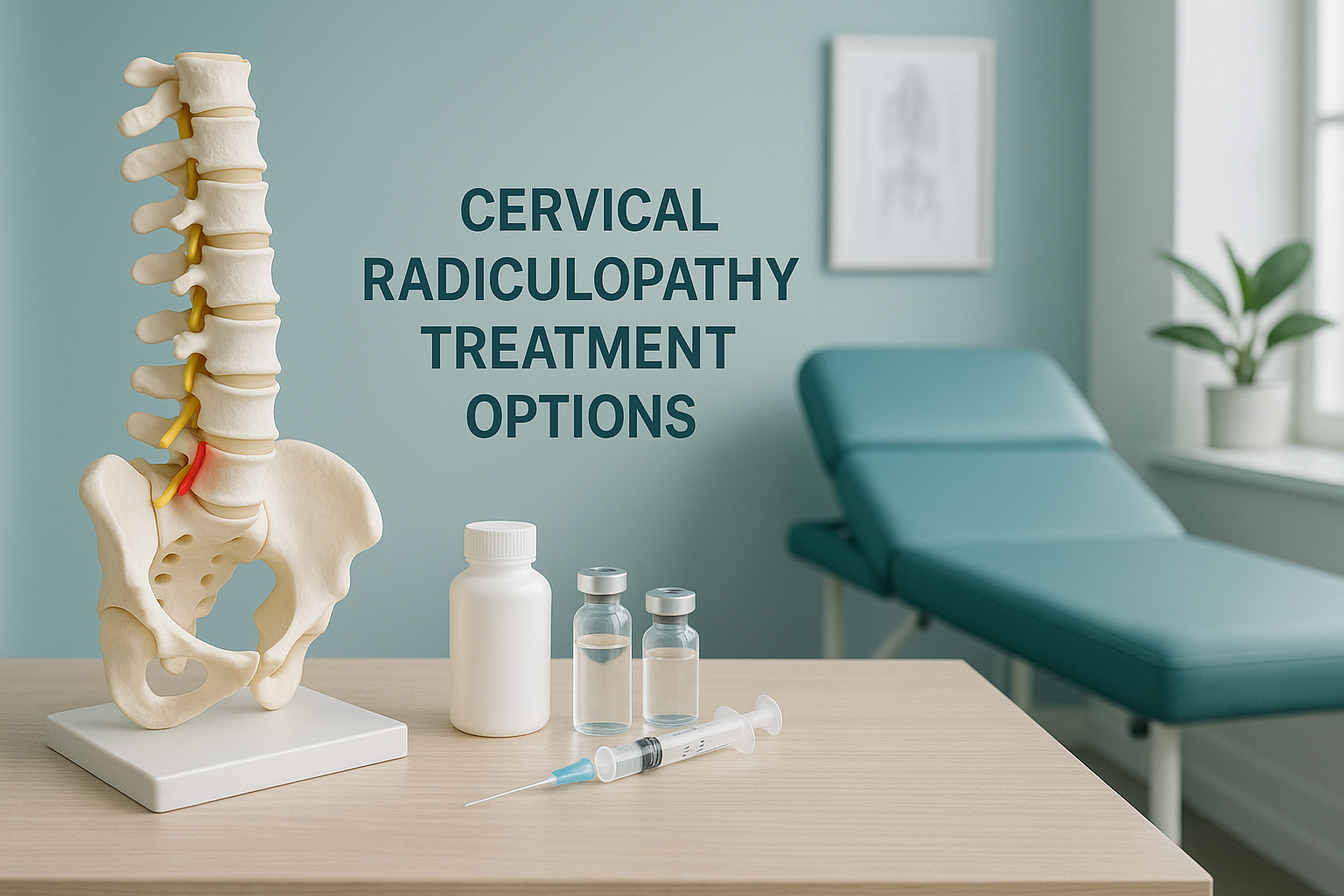
What does a pinched nerve in the neck feel like?
A pinched cervical nerve typically causes symptoms that follow a specific path from the neck into the arm. The exact pattern depends on which nerve root is affected.
Sharp or burning pain that travels from the neck into the shoulder, arm or fingers.
Pins and needles in the hand or fingers, often in a predictable pattern.
Difficulty gripping objects or reduced strength in specific arm or hand muscles.
Restricted neck movement, especially turning or tilting the head to one side.
What non-surgical treatments help cervical radiculopathy?
Most people with a pinched nerve in the neck improve without surgery. Non-surgical cervical radiculopathy treatment focuses on reducing inflammation, easing nerve pressure and restoring movement.
Targeted cervical radiculopathy exercises, stretches and manual techniques to relieve nerve pressure and strengthen supporting muscles.
Over-the-counter anti-inflammatories, nerve pain medication, or a short course of stronger relief as prescribed by a doctor.
A targeted injection near the affected nerve root to reduce inflammation and provide medium-term pain relief.
Adjusting workstation setup, sleep position and daily habits to reduce strain on the cervical spine.
Cervical radiculopathy physical therapy is usually the most important part of recovery. A physiotherapist can guide you through exercises that gently open up the spaces where the nerve exits, strengthen the deep neck muscles, and improve your posture over time.
Cervical epidural steroid injections are often considered when pain is severe and not responding well to therapy alone. They do not fix the underlying cause, but they can reduce inflammation enough for rehabilitation to progress.
When is surgery needed for cervical radiculopathy?
Surgery is usually considered only when conservative treatment has not helped after several weeks, or when there is significant or worsening neurological deficit such as progressive muscle weakness. Most people do not reach this stage.
Common cervical radiculopathy surgery options
ACDF surgery (anterior cervical discectomy and fusion) is one of the most widely performed procedures. The surgeon removes the damaged disc through a small incision at the front of the neck, takes pressure off the nerve, and fuses the two vertebrae together. It has a strong track record for relieving arm pain caused by nerve compression.
Posterior foraminotomy approaches from the back of the neck to widen the bony opening where the nerve exits. This avoids fusion and may suit people with mainly bony compression rather than a large disc bulge.
Cervical disc replacement replaces the worn disc with an artificial one, preserving some movement at that level. It is used in selected patients where the spine is otherwise healthy.
The decision between these approaches depends on where and how the nerve is compressed, and on the overall alignment of your cervical spine. This is where detailed imaging becomes important.
How does standing imaging help plan cervical radiculopathy treatment?
Most neck imaging is done lying down. MRI, CT and standard X-rays all capture the spine in a relaxed, unloaded position. But your neck behaves differently when you are upright and bearing weight. Muscles are active, gravity acts on the whole spine, and alignment problems that hide when you are lying flat can become visible when you stand.

Your body is a connected chain from your feet to your head. If your mid-back is stiff, or your pelvis tilts, your neck may compensate by changing its curve. This can narrow the space around an already irritated nerve. Lying-down imaging does not capture this because gravity is removed and the muscles are relaxed.
An EOS scan takes a whole-body, weight-bearing image while you stand. It uses about 90% less radiation than a standard X-ray, around ten times less. Because the scan captures everything from your skull to your feet in a single exposure, your consultant can see exactly how your cervical spine sits in the context of your full posture. This information helps surgeons and physiotherapists choose the right treatment approach, whether that is a specific exercise programme, a targeted injection, or a surgical plan that accounts for your overall alignment.
A note about MRI. EOS shows bones, joints and alignment in a standing, loaded position. For soft tissue detail such as discs, nerves and the spinal cord, MRI is usually the better tool. Many people benefit from having both types of imaging. Your consultant can advise which combination gives the fullest picture.
Wondering whether standing imaging could help guide your cervical radiculopathy treatment? We offer a free, no-obligation video consultation to discuss your situation.
Book a free video consultationFrequently asked questions about cervical radiculopathy treatment
Yes, many cases of cervical radiculopathy improve within several weeks with rest, activity changes and gentle movement. The inflammation around the nerve often settles on its own, though physical therapy can speed recovery and reduce the chance of it returning.
Most people notice improvement within four to six weeks of starting conservative treatment. Some nerve symptoms such as tingling can take longer to fully resolve. If there is no progress after six to twelve weeks, further investigation or other treatment options may be discussed.
Cervical radiculopathy exercises for pain relief typically include chin tucks, gentle neck retraction, nerve glide (or nerve flossing) movements, and scapular strengthening. These should be guided by a qualified physiotherapist, as the right exercises depend on which nerve is affected and the underlying cause.
ACDF stands for anterior cervical discectomy and fusion. It involves removing a damaged disc from the front of the neck and fusing the adjacent vertebrae. It is one of the most commonly performed spinal procedures and has a well-established record of relieving arm pain caused by nerve compression. Your surgeon is the best person to discuss whether it is right for your situation.
Cervical epidural steroid injections are widely used and generally considered safe when performed by an experienced pain specialist under imaging guidance. As with any procedure, there are small risks, which your treating doctor will discuss with you beforehand.
Lying-down scans relax the muscles and remove gravity, which can hide alignment problems that affect the neck when you are upright. A standing EOS scan captures the spine under real-world conditions, showing how your cervical curve relates to the rest of your posture. This can reveal compensation patterns that change the treatment plan.
Yes. EOS uses about 90% less radiation than a standard X-ray, around ten times less. You can read more about safety and what to expect on our FAQs page.
No. ScanAlign is a private, self-pay clinic. You can self-refer without a GP letter. We start with a free video consultation to discuss whether an EOS scan is appropriate for your situation.
Pricing details are available on our FAQs and cost page. The free video consultation will also help confirm which scan type is right for you.
Posture alone does not usually cause a pinched nerve, but sustained poor posture can increase stress on the cervical discs and joints over time, contributing to wear and narrowing of the nerve exit channels. Addressing overall spinal alignment is often part of a comprehensive treatment approach.
Not sure what is causing your neck and arm pain?
A free video consultation with our team can help you understand whether standing whole-body imaging is the right next step for you.
Book a free video consultationLearn more
Find out how standing whole-body imaging works and what it reveals on the EOS scan overview page, or read more about spinal conditions and alignment.
Sources
- Iyer S, Kim HJ. Cervical radiculopathy. Current Reviews in Musculoskeletal Medicine. 2016;9(3):272-280.
- NHS. Cervical spondylosis (neck pain and stiffness). nhs.uk. Available at: https://www.nhs.uk/conditions/cervical-spondylosis/
- Caridi JM, Pumberger M, Hughes AP. Cervical radiculopathy: a review. HSS Journal. 2011;7(3):265-272.
Written by Abbas Dhami (Specialist Diagnostic Radiographer)
This page is general information and not a diagnosis.
ScanAlign is the trading name of CoreMed Solutions Ltd and operates under The Harley Street Hospital's CQC licence.