
Hip Hypermobility Test: How Do You Check If Your Hip Joint Is Too Loose?
A hip hypermobility test checks whether your hip joint moves further than the normal range. The most widely used screening tool is the Beighton score, which assesses several joints including the hips. A clinician may also use the FABER test to assess hip laxity specifically. If you score highly, standing imaging can reveal how that extra movement affects your alignment under load.
Key takeaways
- The Beighton score is a quick, well-known screening tool for generalised joint hypermobility.
- Hip-specific tests such as the FABER test help a clinician assess laxity in that joint alone.
- Hypermobile hips can cause pain in the hip itself, but also in the lower back, knee or pelvis because the body compensates.
- Standing, weight-bearing imaging shows how loose joints behave under real-world load, something lying-down scans can miss.
- ScanAlign does not diagnose hypermobility, but its EOS imaging helps show the alignment consequences.
What is hip hypermobility?
Hip hypermobility means your hip joint has a greater range of motion than is typical. The ball-and-socket joint moves more freely because the ligaments, joint capsule or surrounding soft tissue are naturally looser than average. Some people are hypermobile in just one or two joints. Others are hypermobile throughout the body.
Having extra flexibility is not always a problem. Many dancers and gymnasts have hypermobile hips and perform well. The trouble starts when the joint is so loose that your muscles struggle to keep it stable, leading to pain, fatigue or repeated minor injuries.

Your body is a connected chain. When the hip moves too far in one direction, your pelvis, lower back and knees often adjust to compensate. That is why hip hypermobility can cause pain in places that seem unrelated to the hip itself.
What are the signs of a hypermobile hip?
The most obvious sign is that your hip moves further than other people's without effort. But there are subtler clues that many people live with for years without connecting them to joint laxity.
A regular click, pop or clunk in the hip during normal movement such as walking or crossing your legs.
A dull ache deep inside the hip joint, often worse after sitting for a long time or after exercise.
A sense that your hip might "give way" during weight-bearing activities, especially on uneven ground.
Lower back pain, knee pain or pelvic discomfort caused by your body compensating for the loose hip.
If you notice several of these signs, especially if you have always been described as "double-jointed", it is worth having your hip laxity assessed properly.
How do you test for hip hypermobility at home?
The Beighton score is the most widely used screening tool. It checks nine points across your body and gives a score out of nine. A score of five or more in adults generally suggests generalised joint hypermobility. Two of the nine points relate to the knee and none test the hip directly, so a clinician may also use specific hip tests.
The Beighton score (simplified)
You can try these five movements at home to get a rough idea. Each side counts as one point.
- Little finger: Can you bend it back past a right angle? (One point per hand.)
- Thumb: Can you press your thumb flat against your forearm? (One point per hand.)
- Elbow: Does your elbow bend backwards beyond straight? (One point per arm.)
- Knee: Does your knee bend backwards beyond straight? (One point per leg.)
- Trunk: Can you place your palms flat on the floor with straight legs? (One point.)
A high Beighton score is a useful starting point, but it does not tell you whether your hip specifically is too loose. That requires a hands-on clinical test.
The FABER test for hip laxity
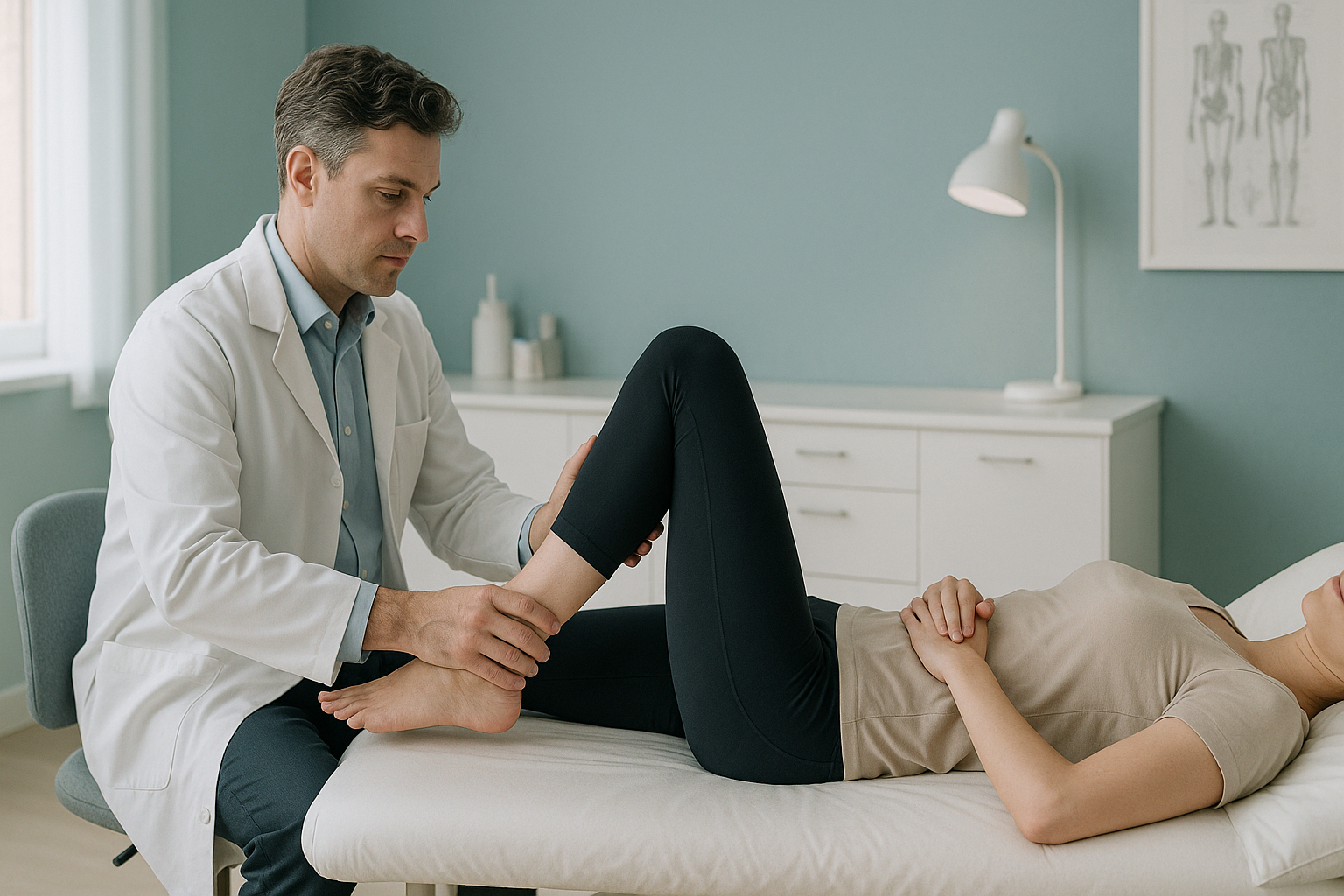
FABER stands for Flexion, Abduction, External Rotation. A clinician asks you to lie down, bend one knee and let it drop outwards while holding your pelvis still. They note how far the knee drops and whether it causes pain. This test can highlight excess hip range, though it also picks up problems in the sacroiliac joint.
Other clinical tests include the hip dial test and the anterior apprehension test, where a clinician gently pushes the femoral head forward to see if it shifts more than expected. These must be done by a trained professional.
Why does a standing scan matter for a hypermobile hip?
Clinical tests tell you the hip can move too far. But they do not show how that extra movement affects your whole skeleton when you are upright and bearing weight. That is the gap a standing EOS scan fills.
Standard imaging, whether X-ray, CT or MRI, is done while you are lying down. When you lie flat, gravity is removed and your muscles relax. A loose hip may look well aligned in that position. Stand up, and the extra laxity lets the femur shift or rotate, tilting your pelvis and changing the curve of your lower back. Your knees may compensate too.
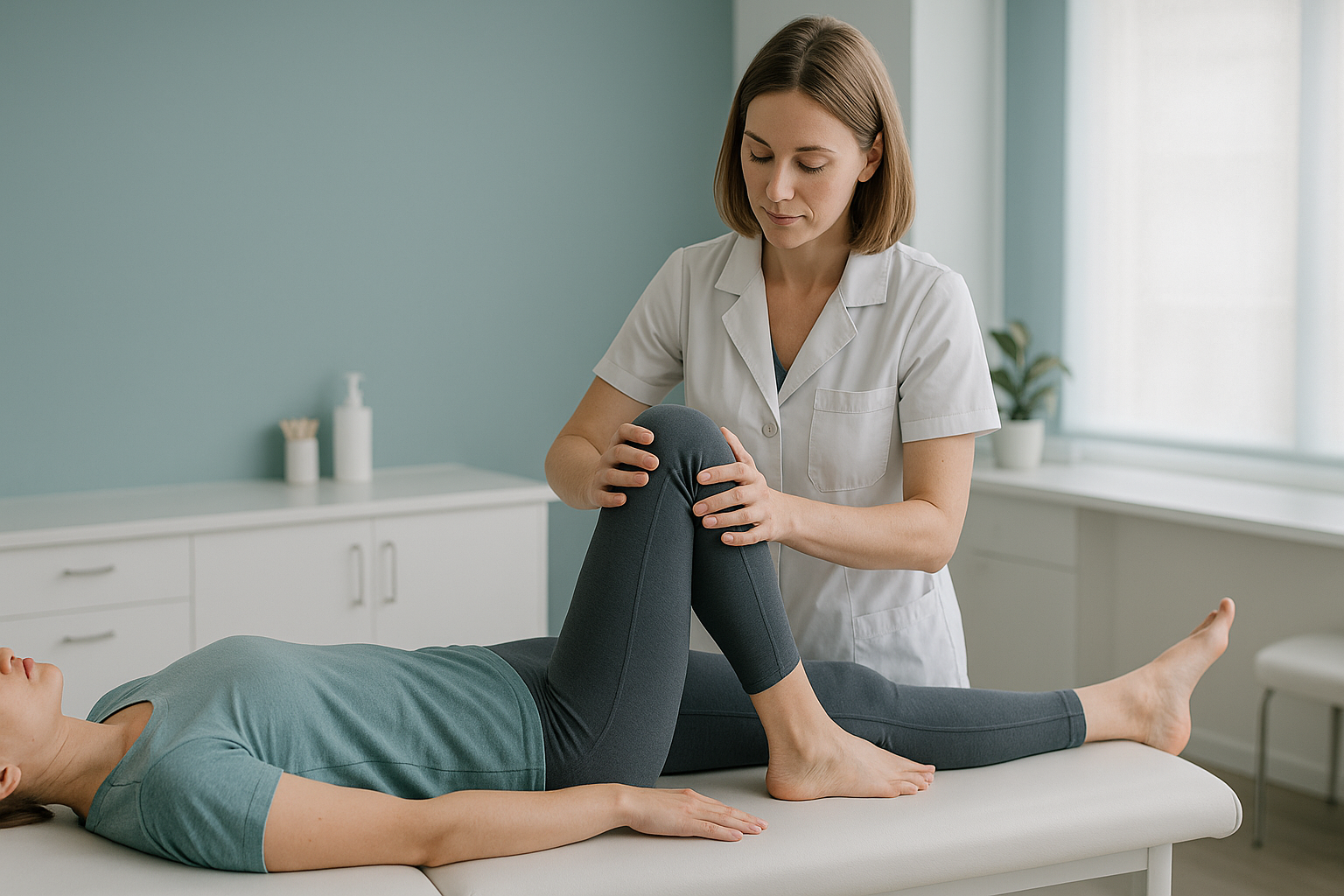
An EOS scan captures your full skeleton, from head to feet, in a single standing image using about 90% less radiation than a standard X-ray, around ten times less. Your report shows exactly how your pelvis, spine, hips and legs line up under real-world conditions. That information is what your physiotherapist, osteopath or surgeon needs to plan the right course of action.
Learn more about how an EOS standing scan works.
When MRI is the better choice: EOS shows bones, joints and alignment clearly. If your clinician suspects a labral tear, cartilage damage or nerve involvement, MRI is usually the better tool because it excels at imaging soft tissue. The two scans often complement each other.
What helps manage a hypermobile hip?
Management depends on how much your laxity affects your daily life. ScanAlign is a diagnostic imaging clinic, so it does not provide treatment. However, the following approaches are commonly recommended by clinicians.
- Targeted strengthening: Building strength in the muscles around the hip, especially the deep stabilisers, helps keep the joint in a better position.
- Proprioceptive training: Balance and body-awareness exercises train your nervous system to control a joint that moves more than usual.
- Activity modification: Reducing movements that push the hip to its extreme range can lower the frequency of flare-ups.
- Accurate imaging: Understanding exactly how your alignment changes under load helps your treating clinician focus their plan. A standing whole-body scan provides this picture.
If your hip instability is linked to a broader condition such as hypermobility spectrum disorder or Ehlers-Danlos syndrome, a rheumatologist may need to be involved. Your GP can arrange this referral.
Wondering how hip laxity is affecting the rest of your alignment? A free video consultation can help you decide whether standing imaging is the right next step.
Book a free video consultationFor more about hip alignment and how it connects to the pelvis and spine, see our page on hip alignment and EOS imaging.
When to seek urgent help
If you experience sudden numbness, weakness in your leg, or any loss of bladder or bowel control, seek urgent medical attention. Contact your GP, call 111 or go to A&E. These symptoms need immediate assessment, not a scan booking.
Frequently asked questions
The simplest screening tool is the Beighton score, which checks flexibility across several joints. If you score highly and also have hip-specific symptoms such as clicking, deep ache or instability, your hip may be hypermobile. A clinician can confirm this with hands-on tests such as the FABER test.
The Beighton score is a nine-point scale that assesses joint hypermobility across the little fingers, thumbs, elbows, knees and trunk. A score of five or more in an adult generally suggests generalised hypermobility. It is quick to do but does not specifically test the hip joint.
You can try the Beighton score movements at home to get a general idea of your flexibility. However, specific hip laxity tests like the FABER test and the anterior apprehension test need a trained clinician to perform safely and interpret accurately.
The FABER test checks for hip joint range and pain. It stands for Flexion, Abduction, External Rotation. You lie on your back, bend one knee and let it drop outwards while the clinician holds your pelvis. It can highlight excess hip range as well as sacroiliac joint problems.
Yes. When the hip is too loose, the pelvis can tilt or shift, which changes the curve of the lower back. Your spine compensates for the instability below, and that compensation can cause muscular strain and pain in the lumbar region. For more on spinal alignment, see our spine imaging page.
When you lie down, gravity is removed and your muscles relax. A loose joint may look well positioned. Standing up re-introduces load, and any laxity allows the joint to shift, tilting the pelvis and changing spinal curves. A standing EOS scan captures this real-world picture.
Yes. EOS uses about 90% less radiation than a standard X-ray, around ten times less. You can find more detail on safety and what to expect on our FAQs page.
No. ScanAlign is a private self-pay clinic. You can self-refer by booking a free video consultation to discuss whether a standing scan is appropriate for you.
Pricing details are available on our FAQs and cost page. We do not list prices on individual condition pages to keep them up to date.
Absolutely. The hip, pelvis and knee are part of the same weight-bearing chain. If the hip is too loose, the knee often compensates, sometimes developing its own pain. A whole-body standing scan shows the relationship between all three. Learn more on our knee alignment page.
See how your alignment looks under real-world load
A free video consultation helps you decide whether standing imaging is right for you. No referral needed. No pressure.
Book a free video consultationWritten by Abbas Dhami (Specialist Diagnostic Radiographer)
Sources
- Beighton P, Solomon L, Soskolne CL. Articular mobility in an African population. Annals of the Rheumatic Diseases. 1973;32(5):413-418.
- Hakim A, Grahame R. Joint hypermobility. Best Practice & Research Clinical Rheumatology. 2003;17(6):989-1004.
- NHS. Joint hypermobility syndrome. nhs.uk. Available at: https://www.nhs.uk/conditions/joint-hypermobility-syndrome/
This page is general information and not a diagnosis.
ScanAlign is the trading name of CoreMed Solutions Ltd and operates under The Harley Street Hospital's CQC licence.