

Hip Pain and Hip Alignment: What Causes It and How Is It Assessed?
Hip alignment describes how the hip joints sit in relation to your pelvis, spine, knees and feet. When alignment is off, your body compensates by shifting load to other areas. This often causes pain not just in the hip, but in the lower back, knee or groin. Standing whole-body imaging can reveal these patterns in a way that lying-down scans cannot.
Key takeaways
- Hip alignment affects your entire posture chain, from your lower back down to your feet.
- Pain from a hip alignment problem often appears somewhere else in the body.
- Lying-down imaging relaxes muscles and can hide alignment issues that only show when standing.
- EOS whole-body standing imaging uses about 90% less radiation than a standard X-ray, around ten times less.
- ScanAlign provides diagnostic imaging only. It does not deliver treatment.
What is hip alignment and why does it matter?
Hip alignment is the position of your hip joints relative to the rest of your skeleton when you are upright and weight-bearing. Your hips are the central link in a chain that connects your spine above to your knees and feet below. When the hips sit level and balanced, your weight is shared evenly. When they do not, something else has to pick up the slack.
Think of it like a building with a slightly tilted foundation. The walls, floors and roof all have to adjust. In your body, this adjustment is called compensation. A hip that sits slightly higher on one side, or rotates forward or backward more than the other, changes the load through your lower back, your knee and even your ankle. Over time, these compensations can become painful in their own right.
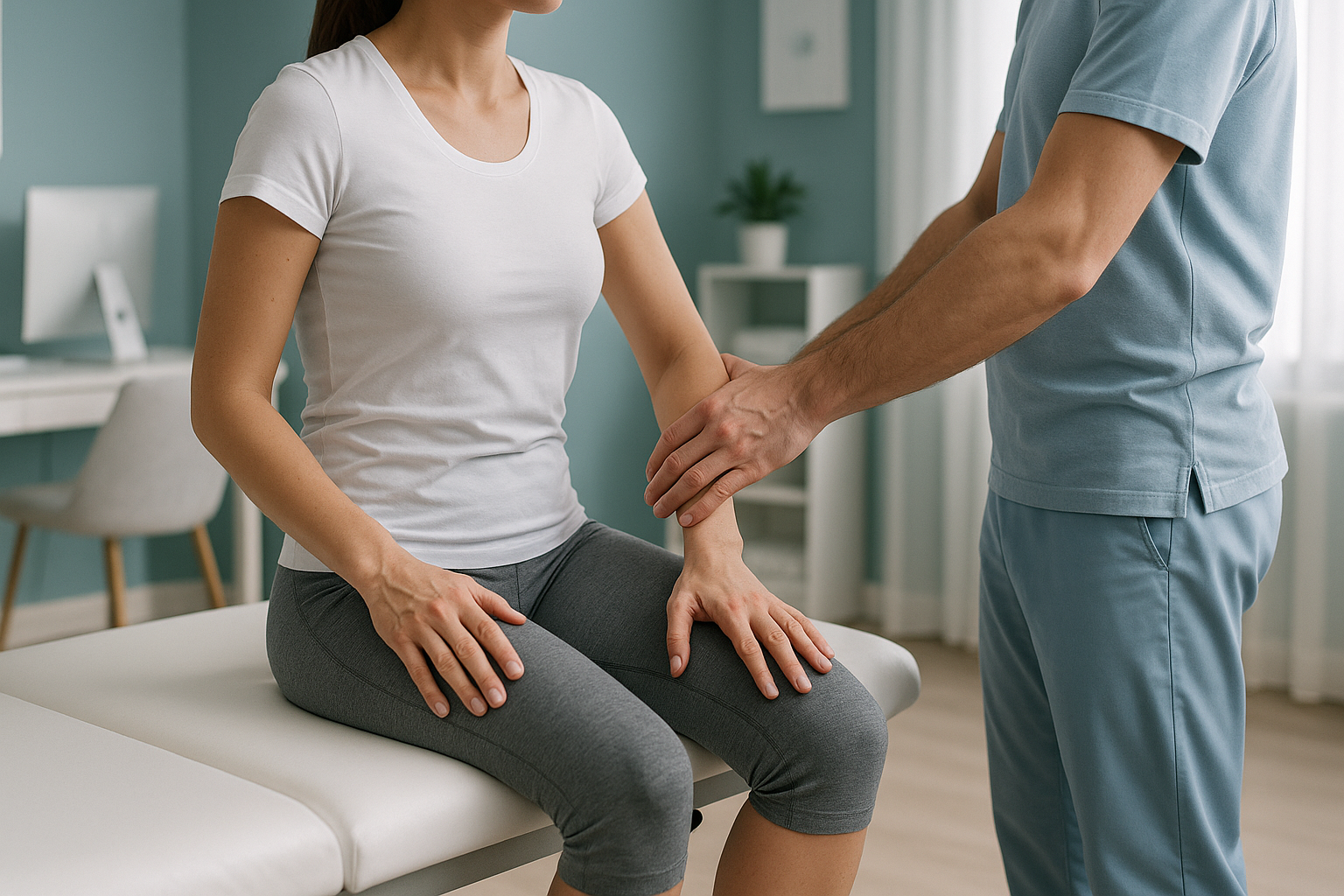
What are the symptoms of hip misalignment?
Hip misalignment symptoms vary widely because the problem rarely stays in one place. You may feel pain directly in the hip, but it is just as common to notice it somewhere along the compensation chain.
A deep ache in the front of the hip that worsens with walking or sitting for long periods.
The spine curves slightly to compensate for an uneven pelvis, loading muscles unevenly.
An off-centre hip changes how force travels through the knee, sometimes causing inner or outer knee pain.
You may notice you lean to one side when walking, or others mention that your gait looks uneven.
If alignment was not optimised during or after surgery, pain may persist or appear in a new area.
Important. If you experience sudden, severe hip pain with numbness, weakness in the leg, or loss of bladder or bowel control, seek urgent medical attention. Contact your GP, call 111, or go to A&E.
What causes hip alignment problems?
Hip alignment problems usually develop gradually over months or years rather than from a single event. Common causes include the following.
Even a small structural or functional difference shifts the pelvis and changes hip loading.
Tight hip flexors, weak glutes or asymmetric core strength can pull the pelvis out of position.
As cartilage wears on one side, the joint space narrows and the hip shifts under load.
Hip or knee surgery can alter how you stand and walk, gradually shifting alignment elsewhere.
Because the body is a connected chain from head to feet, a hip alignment issue rarely stays isolated. It can show up as lower back pain, knee trouble or even shoulder tension. This is why looking at a single joint in isolation often fails to explain persistent symptoms.
How is hip alignment assessed when standing up?
The most accurate way to assess hip alignment is to image the body while it is upright and weight-bearing. When you lie down for a conventional X-ray, CT or MRI, your muscles relax, gravity stops pulling on your skeleton, and any tilt, shift or rotation in the hips can partially or completely disappear. The scan may look normal, even though you feel far from it.
An EOS imaging system captures the whole body, from head to feet, in a single standing exposure. It uses about 90% less radiation than a standard X-ray, around ten times less. Because the image is taken while you stand, it shows how your hips, pelvis, spine and legs actually line up under real-world loading.
The resulting image lets a clinician see whether one hip sits higher than the other, whether the pelvis tilts forward or to one side, whether a leg length difference is present, and how these factors affect the knee and spine. This information is difficult or impossible to gather from a lying-down scan alone.
Want to find out whether a standing alignment assessment could explain your hip pain?
Book a free video consultationWhat helps with hip alignment problems?
Effective management of a hip alignment problem starts with understanding exactly what is out of position and why. Without that picture, treatment can be hit and miss.
Once the underlying alignment pattern is clear, a range of approaches may be considered by your treating clinician. These can include targeted physiotherapy to address muscle imbalances, orthotic insoles to correct a leg length difference, or adjustments to your exercise programme. In some cases, surgical planning benefits from whole-body alignment data, particularly before or after a hip replacement.
ScanAlign does not provide treatment. It provides the detailed standing alignment imaging that helps your physiotherapist, osteopath, orthopaedic surgeon or other specialist make better-informed decisions about your care. You can learn more about hip imaging and hip replacement planning on our dedicated page.
When MRI is the better choice. EOS shows bones, joints and alignment with great clarity. If your clinician suspects soft-tissue damage, disc problems or nerve involvement, MRI is usually the better tool. The two scans answer different questions and often complement each other well.
Frequently asked questions about hip alignment
Yes. When one hip sits higher or rotates differently from the other, the spine has to curve or twist to keep you balanced. This extra load on the lower back muscles and joints is a very common cause of persistent back pain.
It can. The hip, knee and ankle work as a single mechanical chain. If the hip is out of position, the knee often absorbs extra or uneven force, which can lead to pain on the inner or outer side of the knee.
Common clues include one-sided hip or groin pain, a sense that your weight leans to one side, uneven shoe wear, or pain in the back or knee that does not respond to treatment. A standing whole-body image provides a clear, measurable answer.
EOS is a low-dose imaging system that captures your entire skeleton from head to feet while you stand. It shows how the hips, pelvis, spine and legs relate to one another under real weight-bearing conditions. You can find a fuller explanation on our EOS scan overview page.
EOS uses about 90% less radiation than a standard X-ray, around ten times less. It is considered very low dose. Further safety and preparation details are on our FAQs page.
No. ScanAlign accepts self-referrals. You can book a free video consultation directly to discuss whether an alignment assessment is appropriate for your symptoms.
Pricing details are on our FAQs and cost page. You can also discuss options during your free video consultation.
When you lie down, gravity is removed and your muscles relax. Any tilt or shift in the pelvis may flatten out, making the image look normal even though the problem is very real when you are standing and walking.
Targeted exercises can help if the issue is mainly muscular. However, structural causes such as a true leg length difference or joint wear may need different management. Knowing the underlying pattern through imaging helps you and your clinician choose the right approach.
Very much so. Standing alignment data helps surgeons plan implant positioning and leg length balance before surgery. After surgery, it confirms that overall alignment has been restored. Our hip replacement planning page explains this in more detail.
Find out what is really going on with your hips
A free, no-obligation video consultation with our specialist radiographer can help you decide whether a standing alignment assessment is the right next step.
Book a free video consultationWritten by Abbas Dhami (Specialist Diagnostic Radiographer)
Sources
- Dubousset, J. et al. "EOS stereo-radiography system: whole-body simultaneous frontal and lateral radiographs with very low radiation dose." Revue de Chirurgie Orthopédique et Réparatrice de l'Appareil Moteur, 2005.
- National Institute for Health and Care Excellence (NICE). "Osteoarthritis: care and management." Clinical guideline CG177, updated 2022.
- American Academy of Orthopaedic Surgeons (AAOS). "Management of Hip Fractures in Older Adults." Evidence-based clinical practice guideline, 2021.
This page is general information and not a diagnosis.
ScanAlign is the trading name of CoreMed Solutions Ltd and operates under The Harley Street Hospital's CQC licence.