

Kyphotic Lordotic Posture: What Is It and Why Does It Cause Problems?
Kyphotic lordotic posture is a postural distortion pattern where both the upper-back curve (kyphosis) and the lower-back curve (lordosis) are exaggerated beyond their normal range. This creates a characteristic S-shape when viewed from the side, often accompanied by a forward head position and a tilted pelvis. It can lead to pain in several areas at once because each exaggerated curve forces other regions to compensate.
Key takeaways
- Both the upper-back and lower-back curves are increased beyond their normal range.
- Pain often appears in the neck, mid-back, lower back or hips, sometimes all at once.
- Lying-down scans can hide the pattern because gravity flattens the curves.
- A standing whole-body image captures all the curves together, under real weight-bearing load.
- Understanding the pattern is the first step. Targeted treatment depends on accurate imaging.
Your spine is not a straight pole. It has natural curves. A gentle inward curve in the neck (cervical lordosis), an outward curve in the upper back (thoracic kyphosis), and another inward curve in the lower back (lumbar lordosis). These curves work together to absorb shock and keep you balanced when you stand and move.
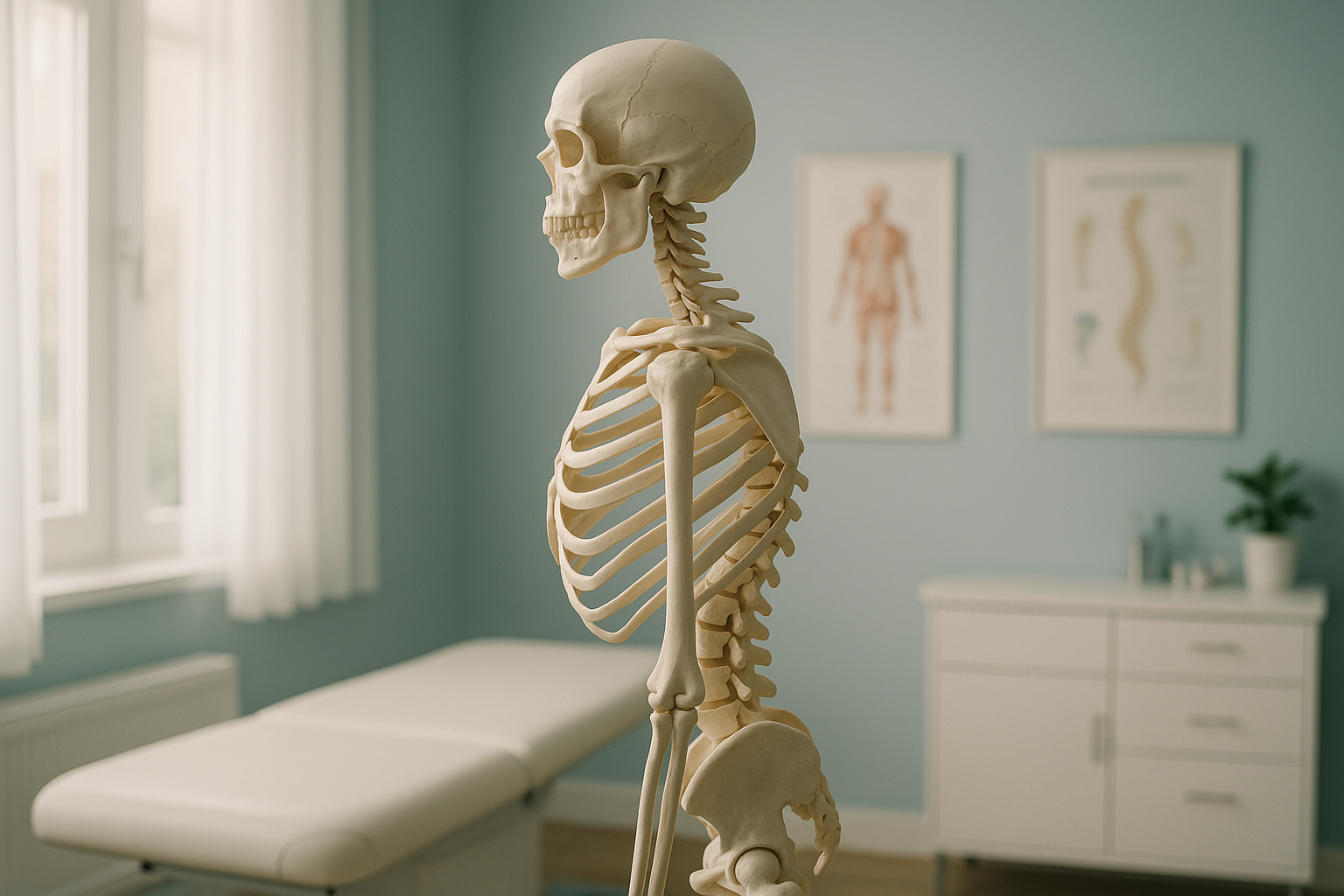
In a kyphotic lordotic posture, sometimes called kyphosis-lordosis posture or one of the Kendall posture types, both the upper-back and lower-back curves become excessive. The result is an exaggerated S-shape. Your head drifts forward, your upper back rounds more than it should, your lower back arches too deeply, and your pelvis tips forward. It is a whole-body pattern, not just one problem area.
What does kyphotic lordotic posture look like?
This postural distortion pattern has several visible and felt signs. You may notice one or many of these.
Your head sits noticeably in front of your shoulders rather than directly above them.
The mid and upper back curves outward more than normal, creating a hunched appearance.
The lower back curves inward excessively, sometimes with a prominent belly even in slim individuals.
The front of the pelvis drops and the back rises, tipping the whole bowl forward.
Neck stiffness, mid-back ache and lower-back pain can all appear together or shift between regions.
How does this pattern differ from normal spinal curves?
In balanced posture, the curves complement each other and the body's weight is distributed evenly. In the kyphotic lordotic posture pattern, the curves amplify each other, shifting your centre of gravity and forcing muscles to work harder just to keep you upright.
The diagram above shows the difference. On the left, the curves are gentle and the head sits over the pelvis. On the right, the head drifts forward, the upper back rounds excessively, and the lower back over-arches, all creating the kyphotic lordotic posture pattern.
What causes kyphotic lordotic posture?
This pattern develops when certain muscle groups become tight while their opposing muscles become weak. Over time, these imbalances pull the spine into exaggerated curves. Common contributing factors include the following.
Hours at a desk tighten hip flexors and weaken the core and upper-back muscles.
Tight hamstrings, weak abdominals, and overactive lower-back muscles tip the pelvis and round the thorax.
Joint shape, disc changes or a previous injury can influence how the spine settles under load.
Years of the same postures at work, in the car or during exercise reinforce the pattern.
Because the body is a connected chain from your feet to your head, a change at one level creates compensation elsewhere. The forward head position often develops to keep your eyes level when the upper back rounds. The increased lordosis may be the lower back's response to a tilted pelvis. Treating only one area often fails because the root cause sits somewhere else in the chain.
How is kyphotic lordotic posture assessed with standing imaging?
A standing, weight-bearing image captures how your spine actually behaves under gravity, which is how you spend most of your day. Traditional lying-down scans (standard X-ray, CT, MRI) relax your muscles and allow gravity to flatten the curves. That can make a kyphotic lordotic posture pattern look far less severe than it really is, or hide it entirely.
An EOS scan takes a full-length, standing image of your skeleton from head to feet in one pass. It uses about 90% less radiation than a standard X-ray, around ten times less. Because both curves and every compensating shift are captured together, your clinician gets a complete picture of the postural distortion pattern rather than a snapshot of one region.
Want to see how your whole alignment looks under real standing conditions?
Book a free video consultationWhen MRI is the better choice: EOS excels at showing bones, joints and whole-body alignment under load. If your clinician suspects a disc problem, nerve compression or soft-tissue injury, MRI is usually the more appropriate tool. The two scans answer different questions and sometimes both are needed.
What helps manage a kyphotic lordotic posture pattern?
The first step is understanding exactly where the imbalances lie. Without clear imaging that shows every curve in context, any plan is based on guesswork. Once the pattern is properly mapped, a clinician or physiotherapist can design a targeted approach. Common directions include the following.
- Strengthening weak areas. The deep core muscles, mid-back extensors and glutes are often underactive in this pattern.
- Stretching tight areas. Hip flexors, chest muscles and lower-back extensors may all be shortened.
- Ergonomic adjustments. Workstation setup, driving position and sleep posture can reinforce or reduce the pattern.
- Ongoing monitoring. Repeating a standing image later can show whether the curves are improving, staying stable or progressing.
ScanAlign provides the diagnostic imaging that informs these decisions. We do not provide treatment ourselves, but the detailed alignment data from a standing whole-body scan gives your treating clinician the clearest starting point possible.
Frequently asked questions
It is a postural distortion pattern where both the upper-back outward curve and the lower-back inward curve are larger than normal, creating an exaggerated S-shape when viewed from the side.
"Bad posture" is a vague term. Kyphotic lordotic posture is a specific, recognised pattern described in the Kendall posture types classification. It involves measurable changes in spinal curves and pelvic position, not just slouching.
Yes. The exaggerated curves place extra load on joints, discs and muscles. Pain can appear in the neck, between the shoulder blades, in the lower back, or in the hips. Sometimes all of these at once, because each region compensates for another.
When you lie down, gravity no longer pulls on your spine in the same way and your muscles relax. The curves flatten and the compensations disappear, so the scan may look normal even when the postural pattern is significant while standing.
An EOS scan is a standing, whole-body X-ray that captures your entire skeleton from head to feet in one image. It uses about 90% less radiation than a standard X-ray, around ten times less. It shows all your spinal curves and joint positions under real load, making it ideal for assessing postural patterns like this one.
No. ScanAlign is a private self-pay clinic. You can self-refer by booking a free video consultation. No GP letter is needed.
Yes. EOS uses about 90% less radiation than a standard X-ray. You can find more details on our FAQs and safety page.
Please visit our FAQs page for current information about costs and what is included.
Many people see meaningful improvement with targeted strengthening, stretching and ergonomic changes, especially when the plan is guided by accurate imaging. The degree of improvement depends on the underlying cause. Structural factors may limit change, while muscular imbalances often respond well.
You will speak with a specialist who will listen to your concerns, review your history, and advise whether a standing whole-body scan is the right next step for you. There is no obligation to proceed.
Where to learn more about spinal alignment
Kyphotic lordotic posture involves the full spine. To learn more about how standing imaging assesses each region, visit our spine alignment page. For a broader overview of what EOS imaging shows, see the ScanAlign homepage.
See your whole alignment, standing
A free video consultation will help you understand whether a standing whole-body scan is the right next step.
Book a free video consultationSources
- Kendall FP, McCreary EK, Provance PG, Rodgers MM, Romani WA. Muscles: Testing and Function, with Posture and Pain. 5th ed. Lippincott Williams & Wilkins; 2005.
- Ilharreborde B, Ferrero E, Alison M, Mazda K. EOS microdose protocol for the radiological follow-up of adolescent idiopathic scoliosis. European Spine Journal. 2016;25(2):526-531.
- NHS. Back pain: overview. nhs.uk. Available at: https://www.nhs.uk/conditions/back-pain/ (Accessed 2024).
Written by Abbas Dhami (Specialist Diagnostic Radiographer)
This page is general information and not a diagnosis.
ScanAlign is the trading name of CoreMed Solutions Ltd and operates under The Harley Street Hospital's CQC licence.