

When Should You See a Specialist for Back, Hip or Knee Pain?
You should see a specialist when pain lasts longer than six weeks, keeps coming back, disrupts sleep or daily activities, or has not improved with rest and simple painkillers. Pain that moves between areas, such as a sore back that starts affecting your hip or knee, is another strong reason to seek further investigation.
Key takeaways
- Pain lasting more than six weeks or worsening over time warrants specialist attention.
- Sudden numbness, weakness, or loss of bladder or bowel control is a medical emergency.
- Pain that moves between your back, hip and knee may point to an alignment problem rather than a single-area injury.
- Lying-down scans can miss problems that only appear when you are standing and weight-bearing.
- A standing whole-body image can reveal the real source and help guide the right treatment plan.
Most adults experience back, hip or knee pain at some point. Often it eases on its own within a few weeks. But when it does not, or when it keeps returning, it can be hard to know whether you should just wait longer or whether something more is going on.
This page will help you recognise the signs that mean it is time to move beyond "wait and see" and get proper answers.
What are the signs your pain needs specialist attention?
You should consider seeing a specialist when your pain crosses from a short-term nuisance into something that affects how you live. Here are the most common warning signs.
Short-term pain usually settles. If yours has not, there may be a structural cause worth investigating.
Pain that gradually intensifies, rather than improving, suggests something is progressing rather than healing.
If pain stops you sleeping, sitting at a desk, or doing everyday tasks, your body is telling you something needs attention.
Recurring flare-ups suggest an underlying cause that has not been identified or addressed.
Back pain that starts affecting your hip, or hip pain that shows up in your knee, may signal a chain of compensation through your body.
If physiotherapy, injections or medication have not worked, the diagnosis itself may be incomplete.
When should you go to A&E instead of a specialist?
Some symptoms need urgent medical attention, not a specialist appointment. If you experience any of the following, contact your GP, call 111, or go to A&E straight away.
Seek urgent help if you have:
- Sudden numbness or tingling in both legs, your groin, or around your bottom
- Loss of bladder or bowel control
- Sudden, severe weakness in one or both legs
- Pain after a significant fall or injury, especially if you are over 50
- Unexplained weight loss alongside your pain
- A high temperature or fever with severe back pain
These can be signs of serious conditions such as cauda equina syndrome or spinal infection. They need same-day assessment, not a planned scan. Do not wait.
Why does waiting too long make things harder?
Waiting too long allows your body to build compensation patterns that can create new problems in areas that were originally healthy. Your body is a connected chain, from your feet to your head. When one joint or region is not working properly, the areas above and below it adjust to pick up the slack.
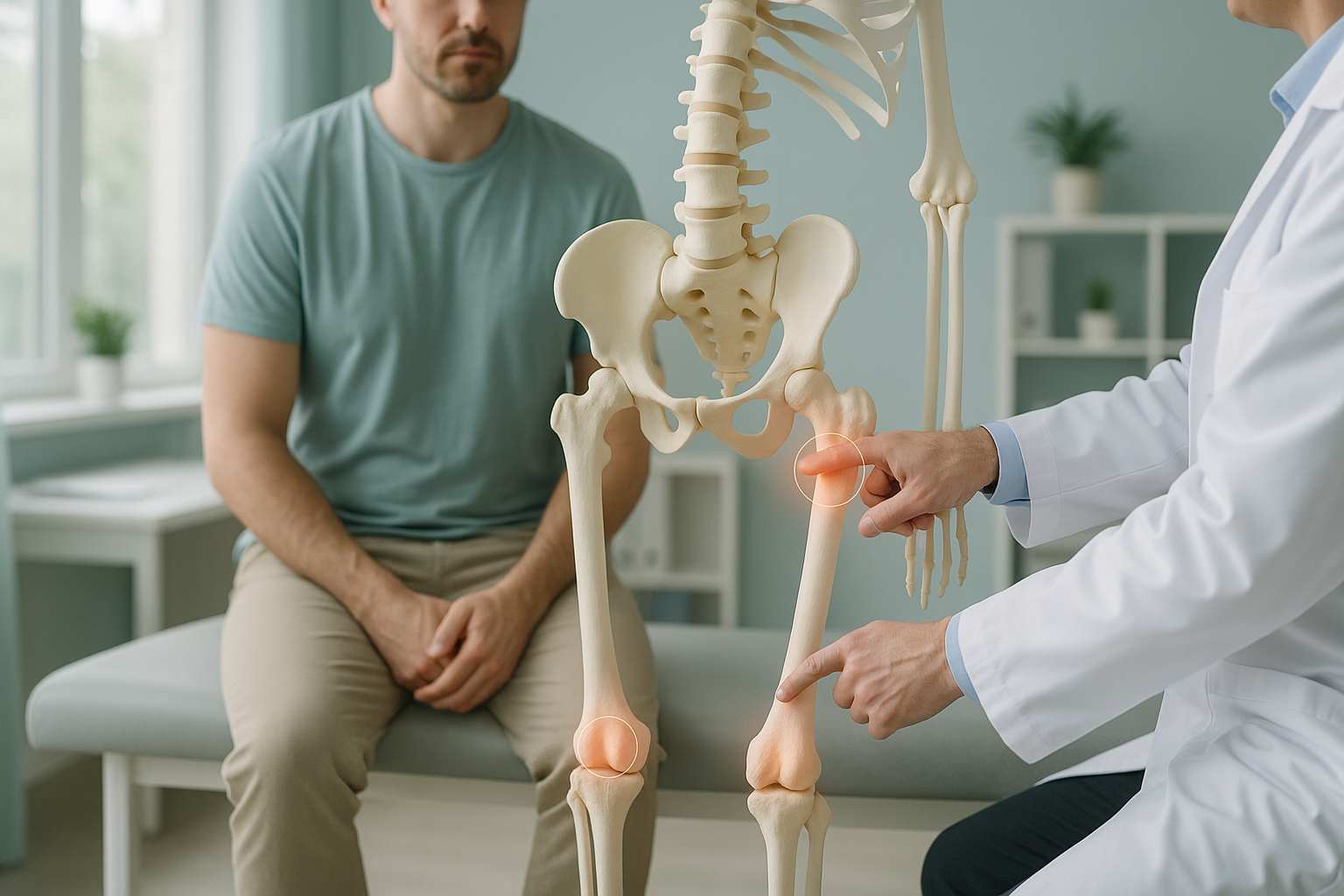
This is why a sore hip can eventually lead to knee pain on the opposite side. Or why a subtle pelvic tilt creates lower back stiffness that no amount of stretching fixes. The longer these compensations run, the harder it becomes to untangle the original cause from the knock-on effects.
Getting an accurate picture of how your whole body is aligned, while you are standing in your natural posture, is the most direct way to find the root cause rather than chasing symptoms.
How does standing imaging show what other scans miss?
Standing imaging captures your skeleton under the real load of gravity, in the posture you actually live in. Standard X-rays, CT and MRI are usually taken lying down. When you lie flat, gravity is removed, your muscles relax, and your joints settle into positions they never hold in daily life. This can hide the very alignment problems causing your pain.
An EOS scan takes a full-length, standing image from head to feet in a single capture. It uses about 90% less radiation than a standard X-ray, around ten times less. Because it captures your whole body at once, your specialist can see the relationships between your spine, pelvis, hips, knees and ankles, not just the one area that hurts.
Want to understand what the scan involves? Visit our EOS scan overview for full details on the process.
When is MRI the better choice? EOS shows bones, joints and alignment. For soft tissue problems such as discs, ligaments or nerve compression, MRI is usually the better tool. The two often complement each other. If your free consultation suggests MRI would be more appropriate for your symptoms, we will tell you.
What should you do if you think it is time to see someone?
The first step is getting a clear, accurate diagnosis. Without one, any treatment you try is based on guesswork. Here is a practical path forward.
If it has been more than six weeks, that is your cue. Further waiting rarely helps.
Ask whether standing, weight-bearing imaging could give a fuller picture than what you have had before.
Your pain might not be where the problem is. Whole-body imaging helps your specialist see the full chain.
ScanAlign is a diagnostic imaging clinic. We do not treat your condition, but we provide the detailed, standing alignment images that help the right specialist plan the right treatment. You do not need a GP referral to book.
For more on what the scan involves and how to prepare, see our frequently asked questions.
Which area is causing you trouble?
If you already know which part of your body is the main problem, these pages go deeper.
How standing alignment imaging helps identify spinal problems that lying-down scans may miss.
Learn more → Hip Hip pain and alignmentWhy hip problems often start with pelvic alignment and show up in surprising places.
Learn more → Knee Knee pain and leg alignmentHow the angle of your whole leg under load affects your knee joint.
Learn more →Frequently asked questions
See a doctor if your back pain lasts more than six weeks, is getting worse, disrupts your sleep or daily life, or has not responded to rest and over-the-counter painkillers. Pain that spreads into your legs or is accompanied by numbness also warrants prompt attention.
Hip pain that limits your walking, keeps you awake at night, or causes you to limp is worth investigating. If it has lasted beyond six weeks, or you notice your other hip, knee or back is starting to ache as well, seek specialist advice.
Knee pain that swells frequently, locks, gives way, or has not improved after six weeks of conservative care should be assessed by a specialist. Persistent knee pain can sometimes originate from a hip or alignment issue rather than the knee itself.
Yes. Your body compensates for problems in one area by shifting load to another. A stiff lower back can change the way your pelvis sits, which alters the angle at your hip and knee. This is why imaging your whole alignment, not just one area, can be so valuable.
No. ScanAlign accepts self-referrals. You can book a free video consultation directly. If your consultant or GP would like to refer you, they are welcome to do so as well.
An EOS scan is a standing, full-body X-ray that captures you from head to feet in your natural, weight-bearing posture. It uses about 90% less radiation than a standard X-ray, around ten times less, and shows how your bones and joints relate to each other under the real load of gravity.
Yes. The radiation dose is about 90% less than a standard X-ray, around ten times less. It is one of the lowest-dose full-body imaging methods available. Further safety details are on our FAQs page.
For current pricing, please visit our FAQs and cost page. The free video consultation is at no charge and has no obligation.
When you lie down, gravity is removed. Your muscles relax and your joints settle into positions they do not hold when you are upright. Alignment issues, uneven leg lengths, and pelvic tilts can disappear on a lying-down scan only to return the moment you stand up.
You will have a short video call with a specialist diagnostic radiographer who will discuss your symptoms, review any previous imaging you have had, and advise whether a standing EOS scan is likely to give you useful new information. There is no cost and no obligation to proceed.
Ready to find out what is really going on?
A free video consultation with a specialist diagnostic radiographer. No referral needed, no obligation, no pressure.
Book a free video consultationWritten by Abbas Dhami (Specialist Diagnostic Radiographer)
Sources
- NHS. "Back pain: when to get medical help." nhs.uk, 2023.
- National Institute for Health and Care Excellence (NICE). "Low back pain and sciatica in over 16s: assessment and management" (NG59), 2016, updated 2020.
- Dubousset J, Charpak G, Dorion I, et al. "A new 2D and 3D imaging approach to musculoskeletal physiology and pathology with low-dose radiation and the standing position: the EOS system." Bulletin de l'Académie Nationale de Médecine, 2005;189(2):287-297.
This page is general information and not a diagnosis.
ScanAlign is the trading name of CoreMed Solutions Ltd and operates under The Harley Street Hospital's CQC licence.